
Mahi-Mahi

Mahi-mahi, also called dolphinfish or dorado, are among our most frequently caught pelagic fish. Good concentrations occur offshore for much of the year.
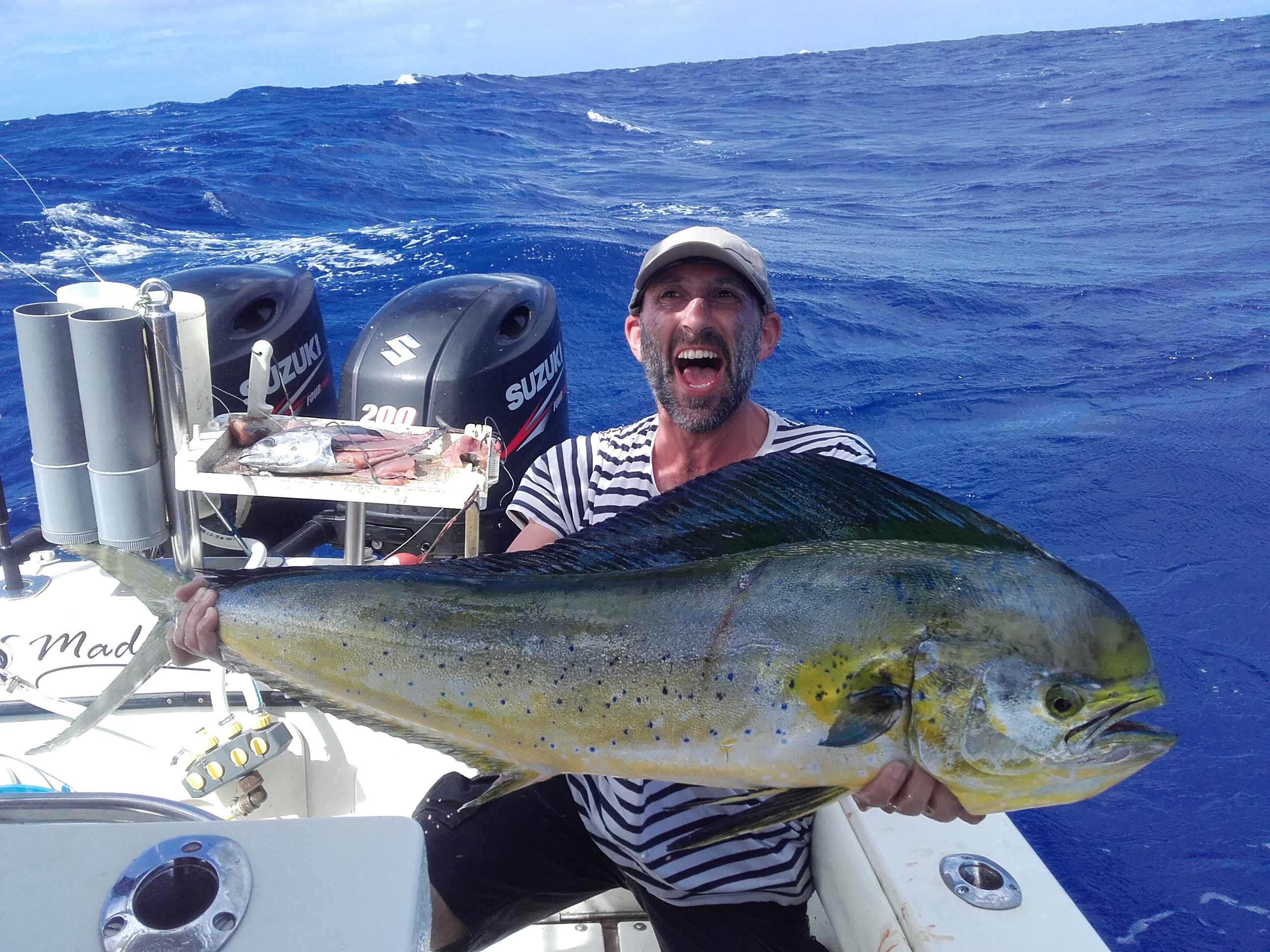
They are beautiful, colourful fish, with a blue-green back, golden-yellow flanks and a white belly. Scattered blue and black spots make each fish distinctive.
Their colours change with their behaviour: an excited, hunting fish can show electric-blue reflections, while a tired hooked fish may turn yellow.

Out of the water, the colours fade quickly, so photographs need to be taken promptly.
Males have a high, square forehead, while females have a rounded profile. The largest fish tend to be males. Mahi-mahi grow rapidly: a one-year-old fish can weigh 5 kg. They mature early and reproduce efficiently.

They generally occur in schools ranging from a few fish to dozens or sometimes hundreds. Competition for food can make them exceptionally eager to attack lures and baits, offering exciting sport fishing.
Yet these surface predators can be unpredictable.

One moment they compete for a lure or bait; the next they completely ignore it, swimming beside the stationary boat almost within reach. Understanding their behaviour and changing moods is part of the challenge. They are fascinating fish that I love to target.
Read the article about our contribution to mahi-mahi research: we tag and release many fish through the American research programme.
See also the mahi-mahi section of Fishing techniques.
Catches from guided trips
Click a photo to open the slideshow.