
Fish Species in Guadeloupe
Guadeloupe is home to many sport fish. We adapt the techniques to the fishing areas, seasons and species encountered. Fishing is possible throughout the year.
Explore the species pages and photo galleries below to discover fish we may encounter on a trip in Guadeloupe.
Marlin and Other Billfish

Of the billfish in our waters, blue marlin are the most abundant and grow the largest. They are recognised by their size, pointed pectoral and dorsal fins, and electric-blue colours.
The emblem of big game fishing, blue marlin are sought after around the world. Guadeloupe is fortunate to have good seasonal runs.
More about marlin and other billfish in Guadeloupe
Yellowfin Tuna

Yellowfin tuna visit Guadeloupe’s offshore waters seasonally. Their bright yellow dorsal and anal fins are easy to recognise and can become very long on large specimens, sometimes reaching towards the tail.
Beautifully built, yellowfin are exceptionally powerful and enduring opponents. For their size and weight, they are among the hardest-fighting fish in Guadeloupe.
More about yellowfin tuna in Guadeloupe
Sharks

Sharks are regularly encountered in Guadeloupe’s waters, particularly offshore and around the drop-offs. Many species occur, and we sometimes hook them without specifically targeting them.
Species encountered on trips include oceanic whitetip and mako offshore, and Caribbean reef, silky, lemon and hammerhead sharks around the drop-offs.
More about sharks in Guadeloupe
Wahoo

Wahoo are pelagic fish found offshore and along deep drop-offs from around 80 metres. Built for speed, they are recognisable by their striking electric-blue vertical stripes.
Their extremely sharp teeth mean they must always be handled carefully, even when dead. Carelessness can cause serious injuries, as a friend discovered when bringing one aboard.
More about wahoo in Guadeloupe
Mahi-Mahi

Mahi-mahi, also called dolphinfish or dorado, are among our most frequently caught pelagic fish. Good concentrations occur offshore for much of the year.
They are beautiful, colourful fish, with a blue-green back, golden-yellow flanks and a white belly. Scattered blue and black spots make each fish distinctive.
More about mahi-mahi in Guadeloupe
Porgies and Snappers

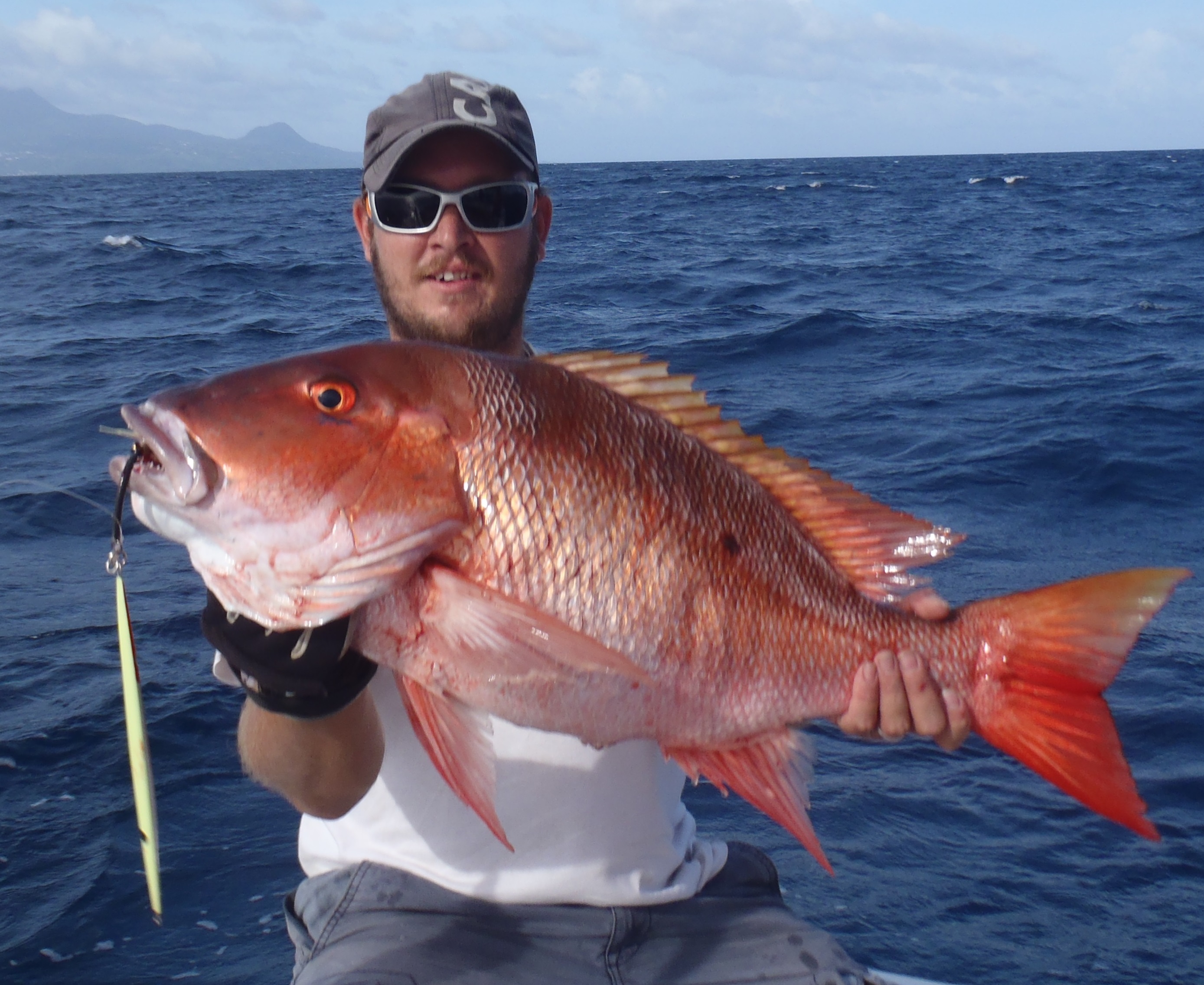
Guadeloupe’s coastal waters hold a varied range of fish known locally as “pagres”. These are the species we most often encounter, though there are others.
The most frequent catch is the pink “pagre rose”, found from the coast to drop-offs around 130 metres deep. It has pink colouring and a dark patch towards the rear of the flank.
More about porgies and snappers in Guadeloupe
Kingfish, Cero and Mackerel

These toothy predators inhabit the coastal zone. We encounter three species: kingfish, cero and, less frequently, Spanish mackerel.
Kingfish are the most common and grow the largest: they are something of a local counterpart to dogtooth tuna.
More about kingfish, cero and mackerel in Guadeloupe
Groupers

Groupers share the same habitats as the fish known locally as “pagres”. These bottom-dwelling fish remain close to holes where they hide at the first sign of danger. Guadeloupe has many species, but some have become rare. To help preserve this diversity, we do not specifically target them.
Commoner small species include those known locally as “grande gueule”, golden with large red spots, and “tanche”, red with white spots. Both are colourful fish traditionally prized for eating in the Caribbean.
More about groupers in Guadeloupe
Barracuda

Barracuda are among Guadeloupe’s most widespread large predators. Originally mainly coastal, they inhabit a wide range of depths, including very shallow water.
In recent years, I have noticed them increasingly offshore. My impression is that declining prey close to shore may play a part.
More about barracuda in Guadeloupe
Blackfin Tuna, Skipjack and Bonito

Alongside yellowfin tuna, covered on a separate page, smaller tuna are widespread around Guadeloupe, from coastal waters to the open sea.
They are an essential link in the food chain that supports larger pelagic predators.
More about blackfin tuna, skipjack and bonito in Guadeloupe
Jacks and Trevallies

Jacks and trevallies are highly prized by sport anglers for their impressive fighting power. The best-known is the giant trevally, or GT, which grows particularly large. It does not occur in Guadeloupe.
We regularly catch many other jack species, in various sizes, around drop-offs and rocky banks at different distances from the coast.
More about jacks and trevallies in Guadeloupe
Amberjacks

Amberjacks belong to the jack family but have a more elongated body and lack the prominent bony scutes along the lateral line. Their powerful mouths have fleshy lips.
Their pearly colours include a dark brown back, a yellow stripe along the flank, lighter brown sides and a pale belly.
More about amberjacks in Guadeloupe
Rainbow Runner

Rainbow runner, called “colas batard” locally, are beautiful, streamlined fish found around floating objects offshore and along drop-offs closer to the coast.
Their bright colours include a blue-green back, two electric-blue horizontal lines surrounding a yellow stripe on the flanks, and a pearly-white belly.
More about rainbow runner in Guadeloupe
Queen Snapper

Queen snapper, known locally as “œil de bœuf”, are bottom fish found beneath the drop-offs in depths of around 180 to 300 metres.
They have a streamlined body, brilliant red and pink colouring, and huge dark eyes with pink surrounds. They are voracious and relatively unwary.