
Fishing Techniques in Guadeloupe
I offer introductions, advanced tuition and guided trips using the techniques below. The choice depends on your preferences, the season and weather conditions.
We often use several techniques in a day as opportunities arise, leaving in the morning with around twenty rods. If we catch a bonito or small tuna while jigging, a live bait outfit is ready. When repositioning for another drift, we may troll two or three lines to make the most of the time and catch a baitfish.
Drifting with live bait: big game fishing

For a keen angler, few experiences compare with taking on a large fish on spinning tackle.
Targeting large yellowfin tuna or marlin with live bait has become one of my specialities offshore. Their first run can be extraordinary, sometimes taking hundreds of metres of 100 lb braid from a Stella 20000 even with a heavy drag setting.
These demanding fights can last several hours. On the largest fish, anglers often take turns.
Main targets: blue marlin, white marlin, sailfish, wahoo, mahi-mahi and yellowfin tuna.
High-speed trolling for wahoo

This exciting technique can bring repeated strikes. Winter often brings a strong wahoo run, usually coinciding with less floating sargassum.
Over the years, I have developed this variation on marlin trolling, fishing six or seven rods at once with outriggers. It can bring plenty of action and hard fights.
Main targets: wahoo, barracuda and mahi-mahi.
Heavy trolling on spinning tackle

The aim is a memorable first run and a large fish on spinning tackle.
As sargassum became more frequent, I developed this alternative to deploying a full heavy-trolling spread. The strike and first run while the boat is moving can be extraordinary.
We use heavy, high-quality tackle, often holding the rod for a more direct experience: Stella 20000 reels, 100 lb braid and a carefully adjusted drag. It is physically demanding fishing.
Main targets: blue marlin, white marlin, sailfish, wahoo, mahi-mahi and yellowfin tuna.
Jigging and vertical fishing

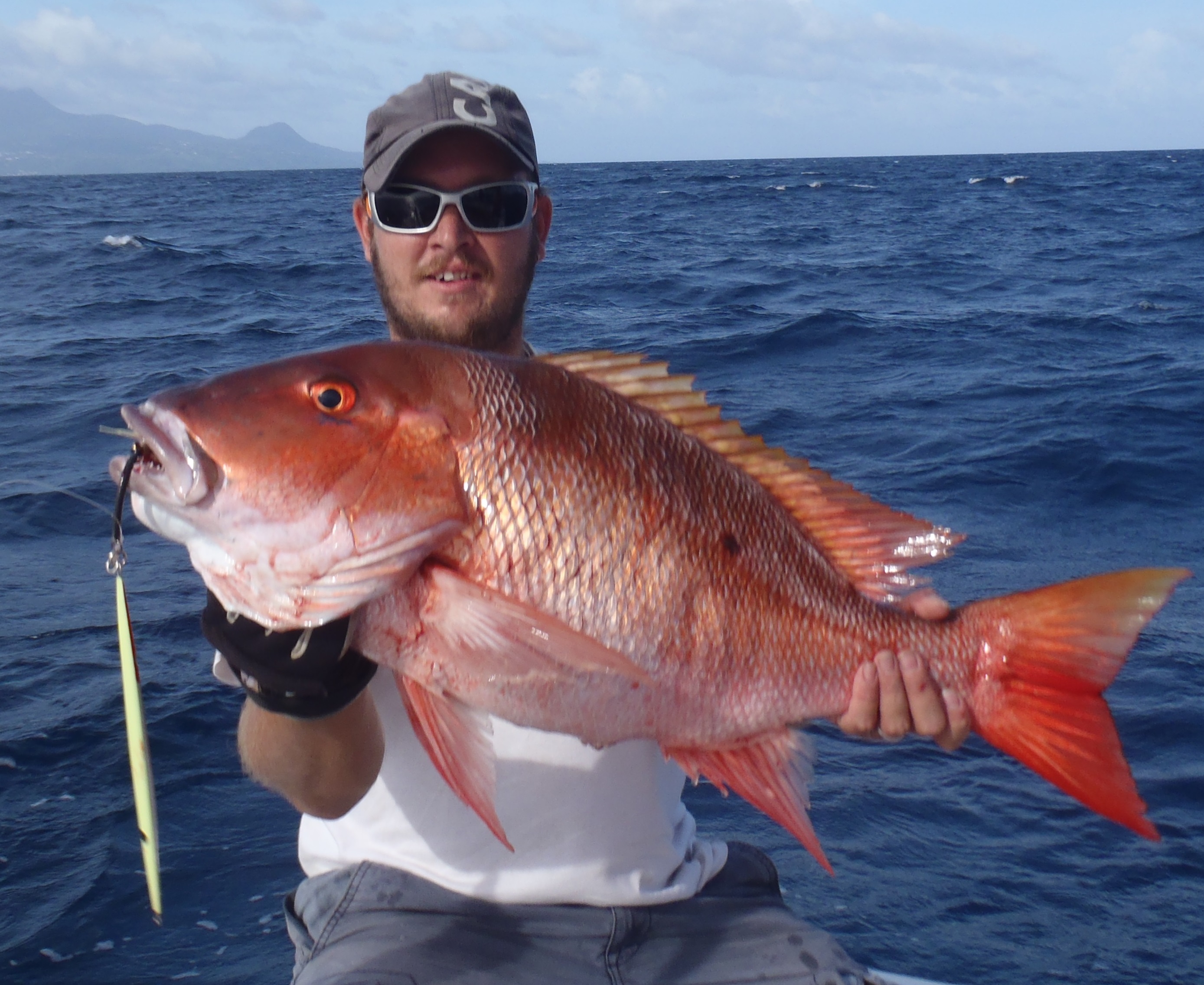
An active, absorbing technique with sudden, powerful strikes. A weighted lure is lowered beneath the drifting boat, then retrieved with a particular action.
The principle is accessible to beginners, though the fishing can be physically demanding. We use dedicated tackle in depths of around 30 to 220 metres, over drop-offs, uneven ground and around offshore fish aggregating devices (FADs). A good fishfinder is particularly valuable.
Species encountered: sharks, wahoo, kingfish, mackerel, porgies and snappers, amberjacks, groupers, black jacks, African pompano, blackfin tuna, rainbow runner and barracuda.
Light jigging and finer vertical techniques

A little finesse among the heavy hitters! Lighter, more sensitive outfits open up a different range of fish. Average sizes may be smaller, but catches can be more frequent, with occasional surprises.
Playing a good fish close to the limits of light tackle is exciting. Light jigs, soft plastics, madai and inchiku are less tiring to work and suit a broad range of anglers.
Main targets: kingfish, mackerel, porgies and snappers, amberjacks, groupers, black jacks, African pompano, blackfin tuna, rainbow runner and barracuda.
Shark fishing with live bait or giant fireball rigs

The first run can be impressive. Years of exploring have helped me identify feeding areas along deep drop-offs where we encounter powerful sharks.
Although sharks sometimes take jigs or trolled lures, we mainly use weighted live baits or dead baits on wired fireball rigs. When a shark runs hard, we may need to follow under engine to prevent it emptying the reel.
All sharks targeted on these trips are released. Protecting them matters because of their role in the ecosystem and the pressures facing shark populations.
The largest shark caught aboard was a hammerhead estimated at close to 5 metres, after a fight lasting almost three and a half hours.
Traditional mahi-mahi fishing, adapted to rod and reel

A precise, exciting technique that involves interpreting the behaviour of seabirds.
Migrating mahi-mahi occur in large numbers in our waters. I love targeting them for their changing colours, strength and aerial fights.
They take poppers and other surface lures, trolled lures, and baits such as ballyhoo or pieces of bonito. I have adapted the local handline technique to long, slender rods, making it a pleasure to fish. The boat’s weighed record is 34 kg.
I also participate in an American mahi-mahi research programme, tagging and releasing many fish. Read more in the news articles.
Poppers and surface casting

Surface strikes among feeding fish are an exciting sight. Casting heavy, strongly hooked lures requires care and some technique to avoid injuring other anglers.
We mainly target mahi-mahi with poppers and stickbaits, which can provoke enthusiastic attacks. We also cast poppers or specialised spoons at surface-feeding tuna when we find them, though this is less common over the deep water we fish.
Heavy trolling and big game fishing

A classic way to take on blue marlin. Fights with fish weighing hundreds of kilos can last hours. This technical fishing demands attention to every detail.
The sound of a Tiagra reel screaming on the strike can stay with you for years, along with the memory of a remarkable fish.
Sargassum sometimes makes heavy trolling difficult. I favour strong marlin runs or periods with fewer floating weeds to improve our chances and avoid spending the trip clearing the lines.
Main targets: blue marlin, white marlin, sailfish, wahoo, mahi-mahi and yellowfin tuna.
Light coastal trolling

A lighter approach close to shore, combining fishing with a view of Guadeloupe’s coastline. Bites can be more frequent than in offshore heavy trolling, and fine lines make even smaller fish exciting.
A day trolling around Les Saintes, with a picnic in a beautiful bay, is a memorable way to discover the islands. We generally mix coastal trolling with more active techniques for variety.
Main targets: mahi-mahi, wahoo, kingfish, mackerel, jacks, blackfin tuna, bonito, rainbow runner and barracuda.
Tell Julien which techniques you would like to discover or improve.